Not every end-of-year gathering needs a countdown to midnight or a list of improvements for the next twelve months. A memory-jar night makes room for the ordinary moments that might otherwise disappear: a funny phrase, a song from a car trip, the first attempt at a new hobby or a day when someone showed up for you. Keep the activity optional and the format small. A paper envelope works as well as a jar, and nobody has to explain whether their year was a good one.
Give the gathering a gentler invitation
Try: “Come for a small end-of-year catch-up and a few little keepsakes. Bring a clean container or envelope if you have one, plus a memory you would enjoy keeping. No goals presentation, no midnight requirement and no need to describe your whole year.” Add your own time, date and location. Ask about the group’s comfort with personal sharing before planning a public reading. A guest may want to make a private collection, draw a picture or simply sit with the group. That choice should not require an explanation.
Choose a container that suits the person
Use a clean, dry jar with smooth edges, a small box, a paper envelope or a folded-card pocket. Avoid making glass essential when children, travel or breakage make another option easier. Set out ordinary paper strips, pens and a few paper scraps for a label. Ribbon and a hole punch are optional. Choose a container big enough for a handful of folded notes rather than a year’s worth of ambitious homework. The little jar of possibilities starter can help with the making direction; check your own supplies before preparing a group session.
Put a menu of prompts on the table
Offer prompts people can choose freely: a song that became part of the year; an unexpectedly good ordinary day; something funny you learned; a place you liked being; a sentence someone said; a small kindness; a thing you made; something you are glad you tried. Include a blank slip labeled “Anything else.” Memories do not need to be achievements. People can write about what they want to remember without pretending the whole year was easy. Keep difficult experiences private unless a guest wants to share them with the group; the activity should not demand gratitude or a positive spin.
Make a tiny year label
Write the year in clear lettering, then add three drawn shapes or paper pieces that remind the maker of it. A book, a cup and a little star can say enough. Put a first name on a shared-table container only when the maker wants it labeled. For a decorative envelope, fold a strip of paper around it as a removable band; that avoids needing special hardware. Test one fold or paper pocket before using it to hold everyone’s notes. Keep glue away from the inside where memories will sit, and let any decoration dry before packing.
Offer one quiet activity and one group moment
Give people ten or fifteen minutes to write privately, with conversation continuing at a comfortable volume. Then invite a single optional read-aloud: one funny line, an everyday favorite or a small thing worth keeping. Guests may pass or ask someone else to read a note. Avoid guessing whose private memory is whose. For a shared jar, collect only notes people intentionally contribute and agree where the jar will live. A privately made container belongs to its maker; it should never become material for a host’s public social post without permission.
Keep next-year wishes small and optional
Add a different-colored slip for a tiny thing to look forward to: visiting a library together, learning one song, trying a craft or taking a familiar walk more often. This is an invitation, not a contract. You can leave the wish slip blank, keep it separate or skip it entirely. For children, let a drawing count as a complete contribution. For adults who dislike resolutions, suggest a “more of this” note rather than a self-improvement target. There is no follow-up accountability session hidden inside the party unless people explicitly choose one.
Finish early, and keep the memory safe
A suggested hour includes fifteen minutes to arrive and choose materials, twenty for writing and making, ten for an optional sharing round and fifteen to finish and chat. Serve whatever simple refreshments fit the group without making the craft table crowded. Pack each container and return unused personal notes. Agree whether it will be opened next year or whenever the maker needs a reminder. Store it somewhere sensible, not in a place where it will be mistaken for recycling. The year-in-moments book is an alternative for someone who prefers pages. The night is complete when people leave with something they are glad to keep.
MAKE ROOM FOR THE GOOD PART
Your little gathering plan
Before the invitation
Choose an early or late time that suits the group and make personal sharing optional.
At the table
Offer a container, envelope and drawing option. Let guests choose from the memory prompts.
At the finish
Return private notes, label only with permission and agree where any shared collection will live.
A LITTLE LIST TO KEEP
Before everyone arrives
Tick as you plan, or print this guide. Checkmarks last for this page visit.
A couple of things you might be wondering
Is this only for New Year’s Eve?
No. An afternoon during the holiday break or the first week of the new year works just as well. Choose a time that fits the people attending.
What if someone has had a difficult year?
Let them make a private keepsake, draw, write about a neutral ordinary moment or skip the activity. Do not ask them to turn the year into a positive story.
Do we have to buy a special jar?
No. A clean container, small box or ordinary envelope can hold the notes. The contents matter more than the container.
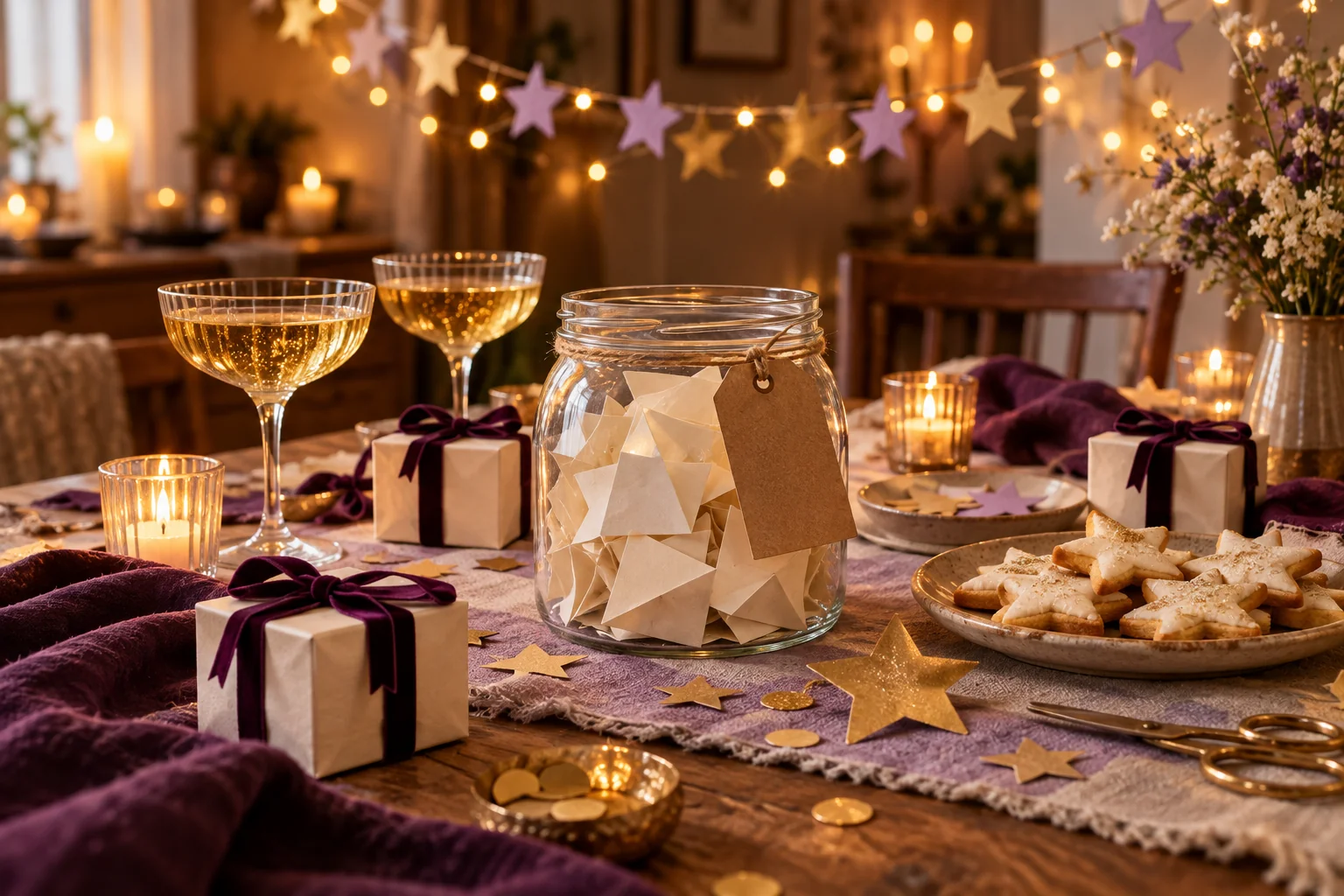
A little jar of possibilities
Let’s make it ↗The related projects are starter guides and have not yet been maker-tested.
Feeling Crafty · feelingcrafty.net/blog/new-year-memory-jar-party/
← Back to the Crafty Notebook